H.G. Wells is undeniably one of the fathers of the Sci-Fi novel. He had quite the vision of what our future could hold and what humanity could accomplish if we were only to put our minds to it. While H.G. Wells does do extremely well telling stories of other-worldly brings and of the consequences wrought by mad-scientists onto our orderly existence, he also shares his hopes with us along with his belief that humanity will always conquer and grow – physically, mentally, and spiritually.
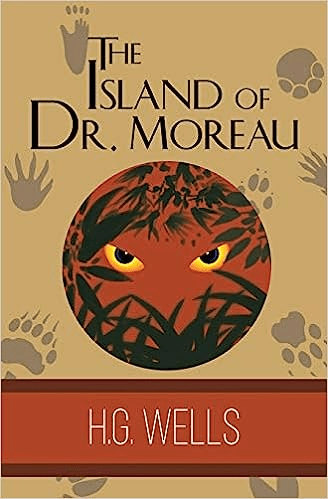
The Island of Dr. Moreau is one of three H.G. Wells novels that I would consider his most classic, well-known works (the other two being The Invisible Man and War of the Worlds which will, of course, come up later on this list).
Dr. Moreau and Victor Frankenstein are kindred spirits in my mind. Both, in their own ways, seek to further humanity and usher us into a new sort of eternity. Victor seeks to defy death; can life be restored to something or someone thought lost for good? Dr. Moreau seeks to find the very essence of what makes a human; where is the line drawn between man and beast, and can it be blurred or erased? Both create life, but they are lives confused by their own existence and made to live separate from the humanity they were modeled after. Whereas Victor is immediately horrified at his creation and seeks to destroy it instead of nurture it, Dr. Moreau creates multiple animal/human hybrids and looks at them only with a critical, spiteful eye. He is their vengeful god, and they live in a fearful reverence of him as they try to follow his rules and smother their animalistic instincts.
In The Island of Dr. Moreau, we get an outsider’s perspective on the doctor’s madness (or genius?) as opposed to the creature’s perspective in Frankenstein. Edward Prendick is practically the audience made into a character. If the story was simply about Dr. Moreau and his creations, our reactions would be quite similar to his. He is humanity’s moral conscience, whereas Dr. Moreau is humanity’s arrogance and greed – destined to be destroyed by the very things he sought to conquer.
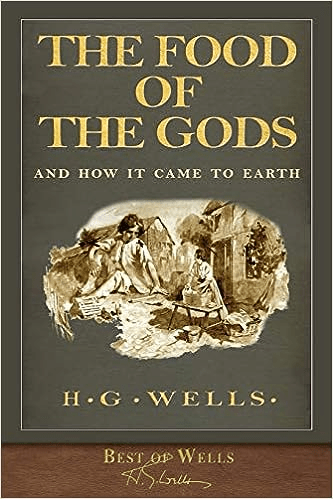
The Food of the Gods has a much more accurate portrayal of scientists than in his other novels. Instead of being driven by some sort of madness or obsession, the scientists in this novel simply make an interesting discovery, test it, lose control of it, shrug their shoulders, and say “That’s the nature of these things. You can’t predict every possible outcome.”
Professor Redwood and Mr. Bensington were unassuming men of science living in relative obscurity before they discovered Herakleophorbia (AKA the food of the gods). Anything that ingests or absorbs this substance will grow to astonishing dimensions – over 5 times its natural size. Rats, wasps, nettles – things that used to just be pests or annoyances – have become deadly. And some people, the first of which was Redwood himself, gave it to their children. As the kids grow into adulthood, shooting up to 40 feet, the fears and grievances of the people in regard to this new upset of nature falls on the giants’ shoulders. Is it possible for the small to live alongside the great?
Everything about this novel worked for me, from the tone to the message I took from it. I think this is Wells’ most playful novels, and yet it’s also one with deep meaning behind it. I call it playful because there’s a lot more humor in it than in some of his other works. The only other one in this list that I’d say is humorous would be The Invisible Man, but The Food of the Gods is definitely more so. The message, however, is a beautiful one. It speaks on a generation’s duty to hand the world over to its descendants. Instead of fearing the change that is inevitable as decades pass and the young progress into positions of power, we should support and ultimately cede control to them.
Cossar, father of 3 giant boys, said it best: “Each man for his own time. And now- it’s their time beginning. That’s all right. Excavator’s gang. We do our job and go. See? That is what Death is for. We work our little brains and all our little emotions, and then this lot begins afresh. Fresh and fresh! Perfectly simple. What’s the trouble?”

The Invisible Man is another mad-scientist tale, and even though Griffin’s experiments are less obviously unethical than Dr. Moreau’s, I’m tempted to say Griffin is madder than Moreau. I feel like you could at least make an argument for Moreau – a weak one, but an argument nonetheless. I feel like Moreau may have started off with good intentions, but I don’t see how Griffin’s experiment could be seen as anything other than a scientific curiosity that turned into an arrogant, selfish obsession.
At first, he is desperate to find a way to reverse the effects of his experiment because it sets him apart from his fellow man in such a strange way, but he ends up going mad with the sense of control he finds that he now has over those around him. His scientific interest deteriorating into the most base, animalistic instinct to be the top predator. By the end, this man of education is literally running around naked in the streets causing as much mayhem as he can. It’s not about the education folks, it’s what you choose to do with that knowledge.

The War of the Worlds is quite possibly Wells’ most popular novel of all. Martians invade Earth!
The imagery used in this novel is some of the best that Wells has conjured. The strange Martian creatures, their towering mobile weapons, the destruction, the chaos of a mass multitude fleeing in panic. Wells describes everything so well with a narrator in the thick of the action that it is easy to transport yourself there with him.
There’s not a whole lot to say about this one. Everyone knows it’s a classic – the blue-print for alien invasion stories. But this wasn’t simply a horror story about what lies beyond; this is a story of hope and faith in humanity. It’s a story of perseverance and the steady strength of humankind.

In the Days of the Comet is, I believe, Wells’ love letter to humanity. He conjures up the most idyllic future he could possibly think of and asks us, “Why can’t we have this?”
In most of Wells’ other novels, his characters are really the mechanism for change and revolution. In the Days of the Comet is different as he instead uses a deus ex machina in the form of a comet to radically change the course of life. When the comet hits, its vapors change the very atmosphere. Everyone and everything that breathes this new air is made anew in a more beautiful world than they inhabited before. The weight of all kinds of suppression, of hate, of anger, of selfishness, of arrogance, of nearly all negative emotions, is lifted from humanity allowing them to see the errors in the way they had been living for so long and how simple it really is to convert to a happier, more productive way of life.
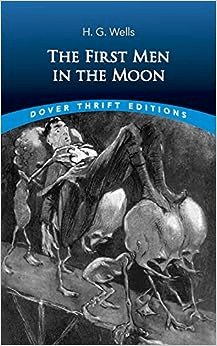
The First Men in the Moon is both an adventure tale and Sci-Fi. Long before Apollo 11, Wells dreamt of what men might find on the moon and how they might get there. Although quite a lot is pure fantasy, it’s interesting to see the bits that he did get right.
This one didn’t engage me quite as much mostly because I didn’t really care for the narrator all that much. But I really enjoyed the bits about the aliens they find on the moon and the way their society is structured. And I didn’t understand the orb they flew to the moon in one bit, but it’s still a fun idea nonetheless!

When the Sleeper Wakes has a very interesting premise but lost me at times with the politics and disjointed descriptions of revolt. That’s just comes down to personal preference though! If you enjoy political thrillers, you’d love this!
A man at the beginning of the novel is fretting so much over the state of his life that he can’t even sleep. A kindly stranger takes the time to speak calmly with him and lets him rest in his home where the man falls asleep and doesn’t wake for another 200 years. He wakes into a completely transformed world and finds out he is the richest man alive – even viewed as a God by some. At first, he is amazed and blinded by the extraordinary transformation that society has undergone. But he finds that the change is truly only surface level. Class divisions and social unrest are even more prevalent in this seemingly idyllic future than it was in the past that seemed like only yesterday to him. Only now, he has the power to make a change.
The main message I think Wells’ was trying to convey with this novel is that none of us should sit idly by if we have the chance to make a difference to those who suffer.
 For All Story Lovers!