Ever since the advent of the printing press, mediums to share thoughts and ideas have continued to evolve and become more inundated into our everyday lives. With the creation of radio, television, and the internet, we were given instant access to breaking news and any information we could ever want to know at the push of a button or a click of a mouse, but we are also force-fed propaganda and the demands of millions of people who command that you to believe what they believe. This list contains books that I believe everyone would benefit from reading – whether you are looking for yourself or already stand strong in who you are. The discussions these books contain are vital for us all to look deep within ourselves and ask, what do I believe?
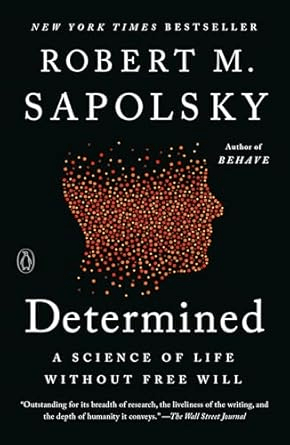
Determined by Robert M. Sapolsky speaks about our consciousness and whether we truly have free will, and if it even matters whether we do or don’t. He speaks on essential questions around punishment, morality, and living well together through these questions about free will and the biological equivalent side of the coin: our brains.
To me, the impression this book left was in trying to get people to ponder and understand our existence – as a species, as a society, and as a single person in our own head. This is both a philosophical and densely scientific examination of an abstract concept. The author does his best to simplify some of the more complex biological aspects, but the text is heavy in some places for people who aren’t as scientifically inclined. Despite this, the questions posited are worth asking and reading about. And whether you ultimately agree or disagree with the conclusions the author makes, you will at least know for certain your belief on the matter, or at least begin to think about it sincerely.
The intent you form, the person you are, is the result of all the interactions between biology and environment that came before. All things out of your control. Each prior influence flows without a break from the effects of the influences before. -quote from book
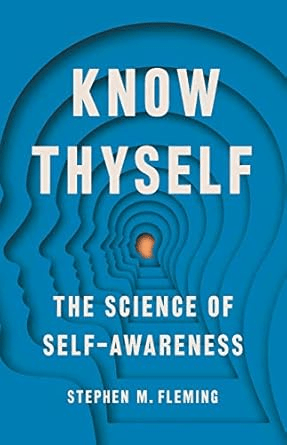
Know Thyself by Stephen M. Fleming discusses the capacity humans have for metacognition. Metacognition, or thinking about thinking, is the most important tool we have for understanding our own mind. It allows self-awareness and also gives us insights into what other people may be thinking. Once we understand it, we can use it to improve the way we interact with others, understand our emotions, and make good decisions.
The message of this book is awareness. A lot of people nowadays suppress or ignore their emotions and this is making it harder for people to connect with each other. I believe this is the root of our loneliness epidemic. This book shows us the incredibly special tool our brains have given us to build communities and foster connectivity, and it all comes from within ourselves. To understand and connect with others, we must start with ourselves.
Self-awareness also enables us to understand that other people have minds like ours. Being self-aware allows me to ask, “How does this seem to me?” and, equally importantly, “How will this seem to someone else?” -quote from book
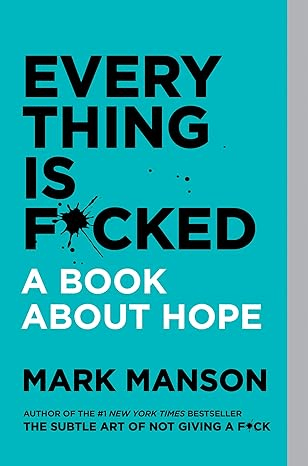
Everything is F*cked by Mark Manson, despite it’s title, is not a doomsday prophecy but a call to look deeper, to dig for the roots of the calamities and unrest around the world right now. Mark Manson uses philosophical and psychological research in order to questions our definitions and uses of major pillars of our societies such as politics, religion, currency, and the internet as well as more abstract concepts such as happiness, hope, and faith. He asks what these things truly mean, and whether we are incorporating them correctly or harmfully.
To me, what Mark Manson is asking of us in this book is to cultivate maturity, both personally and as a species. What maturity entails is understanding and embracing our emotions, thinking for ourselves instead of taking “facts” at face value, and questioning deep seated beliefs and institutions to decide if they are truly beneficial to us.
This is the real work of anything that even resembles psychological healing: getting our values straight with ourselves so that we can get our values straight with the world. -quote from book

God is Red by Vine Deloria Jr. is the seminal work on Native American religious views, asking the reader to think about our species and our ultimate fate in novel ways. Vine Deloria Jr.’s powerful voice informs us about a spiritual life that is independent of Western religion and that reveres the interconnectedness of all living things. He also brings us the truth of the Indigenous peoples’ political struggles all around the world as they are consistently oppressed and torn away from their lands.
This book is about allowing yourself to question your deep-rooted beliefs and learn about the people on the other side of those beliefs. This book is about educating yourself on the aspects of the world and even your own held beliefs that you blind yourself to in order to live a comfortable life. If you don’t allow yourself to question and challenge your beliefs, to see the other side of the equation and try to understand their perspective, then how can you know that your beliefs are truly yours and not just what you’ve been fed your entire life?
Never in my adult life have I highlighted and made notes in the margins of a book so much as I have in this one. This book is filled with earth-shaking insights and so much passion for this world and the people in it, despite all the pain we cause.
Where did Westerners get their ideas of divine right to conquest, of manifest destiny, of themselves as the vanguard of true civilization, if not from Christianity? Having tied itself to history and maintained that its god controlled that history, Christianity must accept the consequences of its past. -quote from book
…identification of Christianity as the opponent and mortal enemy of Communism, Socialism, freethinking, long hair, and other symbolic foes makes their version of Christianity little more than a sacred patriotism seeking to restore the imagined elegance of the last century to American society. -quote from book
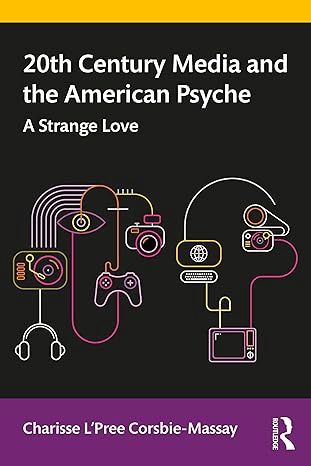
20th Century Media and the American Psyche by Charisse L’Pree Corsbie-Massay applies psychological principles to understand how nine influential media technologies―theatrical film, recorded music, consumer market cameras, radio, network and cable television, tape cassettes, video gaming, and dial-up internet service providers―irreversibly changed the communication environment, culture, and psychological expectations that we then apply to future media technologies.
The overall idea this book conveys is the unique connectivity that the accumulative media inventions of the past few centuries have had on us as societies. We invent and shape these mediums, but they shape us as well. Understanding the way these highly technological inventions have become so integral to who we are individually and culturally and how we connect with others is vital in order for us to use them more mindfully going forward.
In order to cope with an unending stream of content, users came to trust media technology above and beyond their own capacity to judge messages independently. -quote from book
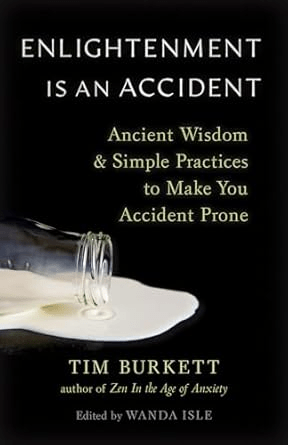
Enlightenment is an Accident by Tim Burkett is the cultivation of Burkett’s decades of practice and teaching of the Buddhist method of Zen. Enlightenment continues to be misunderstood as a project to be completed, a goal to be achieved, or a prize to be awarded. Tim Burkett’s book unhooks enlightenment from the hot air balloon of ego and brings it back down to earth.
This book gives us suggested ways of adopting the mindset of peace. It’s a goal nearly all of us strive for: to live a peaceful life. However, this is such a lofty and impossible feeling goal that we get overwhelmed and hopeless that it will ever be achieved. This book shows us that instead of striving for a life of peace, we should focus on a single moment of peace. When we allow ourselves moments of silence within ourselves, a little pocket of peace within the turmoil all around us, those singular moments build up and transform us, bringing us closer to enlightenment. Burkett tells us that simple practices lead to big changes.
It takes courage to give your all to something while at the same time letting go of any expectation of gain or fear of loss, but this is what living an awakened life is all about. -quote from book
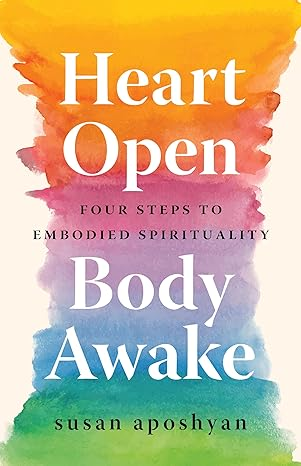
Heart Open, Body Awake by Susan Aposhyan presents a simple yet richly detailed four-part practice to experience the essential link between body and spirit in all its unfolding wonder: opening our hearts, feeling our bodies, allowing ourselves to move and be moved, and connecting with the world in its fullness. Aposhyan weaves together insights from a range of scientific, psychological, and spiritual traditions to present a practical path toward embodied spirituality.
The focus of this book is on embodiment, which Aposhyan defines as “the continuous, complete, and free flow of cognition, emotion, and behavior through our bodies.” Embodiment takes us out of the turmoil, anxiety, and fast-paced world around us to rest in the quiet and peace within ourselves. By listening to our bodies we can find our souls. Once we are connected to our truest self, we can find deeper connection with others.
When we are not clear about our own experience, we often project the unconscious aspects of ourselves onto others. Working with our own emotions is the basis for working with others. Knowing what we are feeling in our hearts and bodies from moment to moment is the basis for working with emotions. -quote from book

