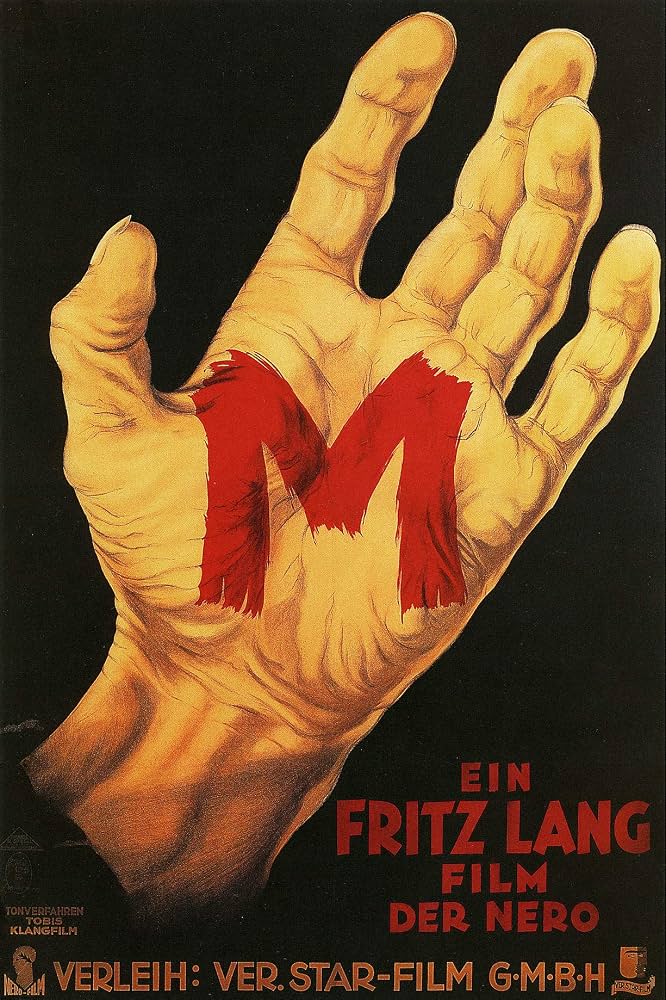
M 1931
Dir. Fritz Lang
Screenplay by Fritz Lang & Thea von Harbou
Just you wait, it won’t be long
The man in black will soon be here
With his cleaver’s blade so true
He’ll make mincemeat out of you!
The film opens on a group of children playing an innocent game, similar to eenie-meenie-miney-mo, but using such a diabolical song. The content of the lyrics and the fact the children are singing it is made even more sinister as we learn from two women that a child murderer is on the loose.
The opening sequence continues as one of the women cooks and sets the table as she waits for her child to return home. The school lets out for the day, with a ring of anxious parents waiting outside the doors to escort their children home, but one little girl named Elsie begins her walk home alone. She bounces a ball as she walks, then stops to bounce it off a wall where a wanted poster describes the recent killings and lists a reward for help catching the killer. A shadow falls over the poster as a man approaches Elsie. He leads her away, whistling a tune, and buys her a balloon. Her place at the table remains empty as her mother becomes more and more desperate, shouting her name out to the street. Elsie’s ball is seen rolling away, and her balloon drifts off into the sky. Elsie never returns home.
The opening may be simple, but it is highly effective in the subtle building of tension. Lang shows no violence, not even a scream off camera. He lets the audience stew over the implications and leaves the details up to our imaginations, which he knows will undoubtedly create horrors worse than he could depict on film.
M is a German mystery thriller film and an early example of a procedural drama. The story, set in Berlin, follows the manhunt for a serial killer who targets children. The man turns out to be one Hans Beckert (portrayed by Peter Lorre). It also highlights the disintegration of trust in community and justice in the early years of the decade Hitler rose to power. With an original working title of Murderer Among Us, Lang was almost prohibited from making the film. The head of Staaken Studios was a member of the Nazi party, and he initially refused to let Lang film at their studio believing (from the title alone) that the film was meant to depict the Nazis. The studio head relented once told the plot, but you can feel Lang’s frustration with the state of his nation through his characters, their dialogue, and the palpable angst that continues to build up until the climax of the film. Perhaps the studio head did regret allowing the film to be made, as the messaging embedded in the dialogue often feels anti-fascist. Take for example, a line of dialogue from the Commissioner’s meeting where someone states, “Most of the public still takes the position, ‘How does this concern me?’ The idea that each individual is responsible for what happens to the poorest, most anonymous child on the street hasn’t even dawned on the public at large.” Lang was clearly disgusted by the way society was crippling itself. Just swap the word child out with any of the marginalized groups targeted by the Nazis and you have a call to action or, at the very least, a warning about being complicit by inaction.
The tension in the film builds gradually as we see the community’s fear turn into paranoia and anger. With the newspaper stating, “No one knows him, yet he is among us. Anybody sitting next to you could be the murderer,” friends and neighbors turn on each other, misinterpreting simple interactions and attacking before asking questions. More pressure being put on an exhausted police force lead them to make frequent raids of the seedier parts of town. The crime bosses are losing money, so they band together to find the killer and “put him out of commission.” They enlist the help of the city’s most invisible and innocuous denizens, the beggars, to work as informants and footmen on the street.
Lang is clearly denouncing the vilification of the poor that he was witness to in the world around him. In fact, it is the network of beggars and petty criminals who identify Beckert as the killer and corner him in an office building. He is then carried off by the crime bosses and brought to an abandoned distillery to face a kangaroo court. Beckert finds himself facing a group of criminals, angry citizens, and devastated mothers demanding his head.
The man in charge of this criminal entourage, known only as Safecracker, believes the only way to end Beckert’s reign of terror is to kill him, and he states as much, to which Beckert shouts, “But I can’t help it!”
Beckert demands to know who they are to judge him, the lot of them also being criminals, “Probably proud of it too.” He claims they could just as easily not commit their crimes if they had “learned something more useful,” whereas he had “this cursed thing inside” of him. He speaks of a feeling of “shadowing” himself and of wanting to run away from himself but being unable to escape. Interestingly, two men among the crowd are seen nodding along to his words. Was this only meant to indicate they were listening intently, or do these men understand that feeling? If they do, this does not automatically mean they share his impulses or run from the same demons, but it was an interesting choice to make. It could almost read as empathy for the man. Of course, then Beckert admits that his only solace from the voices, the guilt, and the ghosts of the mothers and children is in the act of killing a child. “Don’t want to! Must!” he shouts, clutching at his chest.
Surprisingly, Beckert is given a representative in the “court.” It is unclear who the man is, but it’s doubtful he actually had any credentials in law. However, he states his case for Beckert, demanding he be turned over to the police as “the state must ensure that this man is rendered harmless.”
The statement gets a big laugh from the gathered crowd, and a voice shouts, “You should ask the mothers!” Then a chorus starts up of, “Kill the monster!” Just as the mob begins rushing at Beckert, the police arrive. Throughout the film, they were investigating a letter sent by Beckert to the press. They also began searching the homes of any recently released mental patients. In Beckert’s home, they found the same brand of cigarettes found at one of the crime scenes and red pencil shavings on the windowsill where he wrote the letter.
The final shot of the film is of Elsie’s grieving mother at Beckert’s trial. She looks directly into the camera and states, “This will not bring our dead children back. One has to keep closer watch over the children…All of you.” This mirrors the line spoken at the Commissioner’s meeting about each individual being responsible for the people around them.
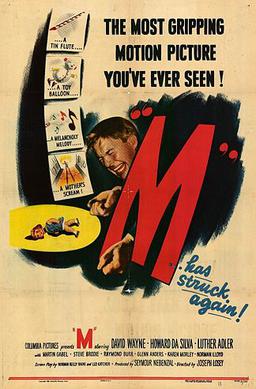
M 1951
Dir. Joseph Losey
Screenplay by Norman Reilly Raine and Leo Katcher
There was an American remake of the film released in 1951 directed by Joseph Losey. The title and overall pacing and main plot points were retained from the original, but the screenwriters updated it for the American public by setting it in mid-century Los Angeles. The underlying themes changed from the Nazis and fascism to instead reflect the rising panic of the “red scare” of Communism. The 50’s also saw advancements in the field of psychiatry which is represented in the way the character of the killer was altered.
This adaptation sought to humanize the killer in a way the original did not. They used the trope of mentally unstable man with an unhealthy attachment to his mother that Robert Bloch would make famous years later with his character Norman Bates in his 1959 novel Psycho.
When compared with Hans Beckert, the American killer, one Martin W. Harrow (portrayed by David Wayne), is timid, flighty, and a bit pathetic. In one scene, having lost the chance to abduct a child after the mother showed up, Harrow picks up a bird and nearly strangles it before letting it free and breaking down in tears.
The scene with the bird is given context during Harrow’s defense monologue in front of the kangaroo court. He speaks about his mother who told him men are born evil and need to be punished in order to be good. He grew up in poverty, watching his mother suffer and warp her sense of the world into something dark and inescapable. He learned to view it the same way too. In his monologue, he tells a story about nursing a bird back to health, but then fearing to set it free again. He stammers that the world is “too ugly and cruel for birds and children. So I knew I had to kill a children- a bird- I had to kill a bird…” He claims he was saving them the pain of living. He understands that he needs to be punished. He wants to be punished, because punishment will make him good. All he ever wanted was to be good for his mother.
Both Peter Lorre and David Wayne gave stellar performances as the killers, especially during their monologue scenes. They manage to convincingly convey distress in a way that garners sympathy but simultaneously still come across as deeply disturbed which negates that pang of sympathy.
Whereas Lang used a grieving mother in the very last shot to convey the important lesson to take away from the film, I found the most poignant message in the American remake was made by the character Dan Langley, who acted as Harrow’s defense at the kangaroo court. One of the women in the crowd demanding Harrow dies for what he’s done speaks up, asking, “What else is there in this life but our kids? What’s to look forward to unless they grow up better than us?” Langley responds, “Will killing him help your children to grow up any different from you, him, or me? My client wanted to be good…What of our own guilt?” Again, we are being reminded of our individual responsibility to the whole. Is it just to execute someone based solely on their actions? What about the injustices acted upon him in his childhood? Does that count for nothing? Capital punishment was in a decline during the 50’s with a shifting of public perception regarding the morality and justice of the act. Combine that decline in capital punishment with the advancement in psychiatry and you get some people who agree that these mentally unbalanced criminals need help, not punishment, while others believe we are being too lenient. This was present in the original German film as well, but it was highlighted more in the American remake.
Overall, both films are effective in portraying the breakdown of society under too many pressures – how paranoia and anger blur the lines between justice and murder. They also both elevate the downtrodden to a level you can see them clearly as part of a whole, not an “other” to be ignored. And, of course, in the killers, they both show us the senseless, sad depravity that humankind is capable of. A depravity that we all must work together to shield the children from

